Printemps (April in Paris)
By Noah Hall
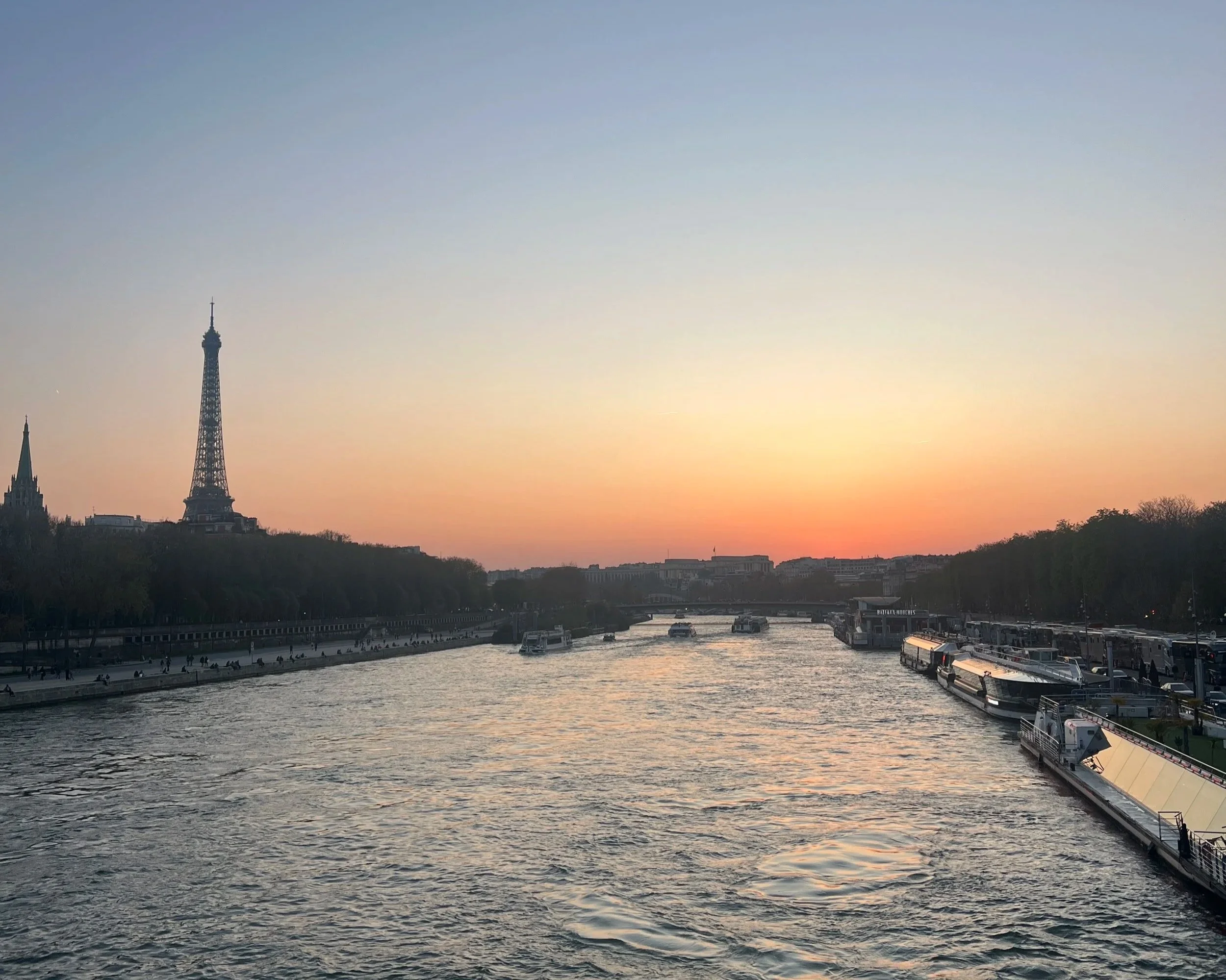
Image By Brynn Rogers
Billie Holiday and I both agree: April in Paris is quite a specific thing to experience. The aroma of sakura drifts downwind into my green nostrils and mixes warmly with the crusted smell of pain coming from a local boulangerie. In the heart of the 11th arrondissement, the city breathes and sweats, and laughs something sweetly guttural. Colorful Parisian figures huddle against grey limestone carpeted by their signature lumpy clouds of grey smoke, and I find everything so wonderfully sensational. Pigeons hobble, dogs meddle, and cigarettes dwindle.
I notice this through the small of world I see above the rims of my sunglasses. Underneath my gaze, Jean Genet rambles on about something I can vaguely understand in my second language. I manage to scribble down a note en français about how dreadful I’m beginning to find French literature. And how that feels like it could be a good thing.
My nose is caught again when a large, broad-shouldered waiter passes by my table with what looks to be a margherita pizza. Though I am not particularly hungry, my mouth waters. I’ve long killed my last cigarette, and I’ve overstayed my welcome at Café Obrkof. I like to think they love me here. Or at least I hope they do, as I’ve made it a point to find a “spot.” And this “spot” happens to be beside a lovely seasonal plants shop, and they get their beans from Argentina. I think. Anyway, it’s good coffee, and it’s only four euros for an americano.
A lengthy young woman with a burgundy coat and wild hair floats past me and into Obrkof. She reminds me of a beautiful woman I’ve seen in a couple Rainer Werner Fassbinder films, though I regretfully can’t recall the woman's name. A moment before, I had the thought to stand up and leave, but I find myself lingering now. I light another cigarette because I don’t know what else to do with my hands, and I learned a long time ago that there’s nothing on my phone.
There’s a quietness in the breeze that hums in my ears and throughout my body. The cafe door opens again, and out comes the Fassbinder woman. I want to say something to her, I say to myself. She looks French, so I should say something in French–which feels obvious. I watch her pose against the drab walls. They make her radiate like a thing deserving of attention. She runs her hands through her full, dark hair, and I begin to wonder if I’m staring too long. The sunglasses are hiding it–I tell myself, rather indifferent. She pulls a cigarette from her coat pocket to light. It appears, almost, to spawn in–as girls like that seem to have the power to do–-but I notice the packaging makes an impression on the coat’s material. She pats her pockets looking for a lighter, I presume, but comes up empty.
And just when I’m beginning to find myself indecent, and my fingertips begin to burn from the cigarette I forgot I had lit, she locks eyes on me and again floats in my direction. I’m not sure if there’s a better word to describe her walk than a float. Not a ghostly sort of float, but like how the sun floats in the sky. Anyway, that is what she is doing, and rather quickly.
I loosen my stiff posture and stamp the lousy butt I clumsily hung onto. Her voice is like the texture of a rose petal when she speaks. She asks me for a lighter, « t’as du feu? » and because I do, I feel an odd sense of importance. Though it’s custom here to just keep a lighter–even if you don’t smoke. In this moment, I am thankful my bad habits have brought her swagger to my bic lighter, because I can see her up close.
Her skin is perfectly, and smoothly, dark honey all over. She studies me a little bit. I can tell because her eyes do a dance, flickering as they trace my body, and the top-right corner of her lip rises to a smirk. Or maybe I’ve been in Paris so long I take any slight facial movements as a sign of humanity, and I’ve forgotten what a smirk is. She puffs her newly-lit cigarette above my shoulder, and mentions seeing me reading Notre-Dame-des-Fleurs. I am always embarrassed when I read in public, for reasons I’m sure aren’t my own. But she says she likes Genet, so I ease up a tad. I’m sure she can tell I’m not French. Not because of my accent, but because I make small grammatical errors and gender errors that I have to pretend I’m not frustrated by.
Her name is Georgiana. I tell her I think it’s a very pretty name, and I am telling the truth. She shuffles to make way for the muscular serveur scooting past her, and her ringed fingers brush the small-and-low of my back. My body tingles something of goodness and gladness, and I am grateful to be loved by a single moment. A moment so small, yet I want it to stain my memory rainbow and let it fill my nostrils with Printemps.